Texts
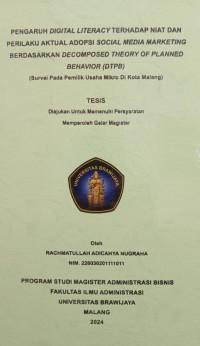
PENGARUH DIGITAL LITERACY TERHADAP NIAT DAN PERILAKU AKTUAL ADOPSI SOCIAL MEDIA MARKETING BERDASARKAN DECOMPOSED THEORY OF PLANNED BEHAVIOR (DTPB) : Survei Pada Pemilik Usaha Mikro Di Kota Malang
RINGKASAN
Rachmatullah, 2024. Program Magister Administrasi Bisnis. Universitas
Brawijaya. “Pengaruh Digital Literacy Terhadap Niat dan Perilaku Aktual
Adopsi Social Media Marketing Berdasarkan Decomposed Theory of Planned
Behavior (DTPB) (Survei Pada Pemilik Usaha Mikro Di Kota Malang)”. Dosen
Pembimbing Utama: Mohammad Iqbal, S.Sos., MIB., DBA Anggota: Drs. Wiyata,
MAB, Ph.D.
Perkembangan teknologi digital semakin pesat termasuk telah mengubah
cara kita berkomunikasi salah satunya adalah dengan menggunakan media sosial.
Kini penggunaan sosial media sudah menjadi bagian tidak terpisahkan dalam
kegiatan kehidupan masyarakat sehari-hari. Media sosial ternyata juga berperan
dalam Digital Economy yang digunakan untuk pemasaran atau dapat disebut
Social Media Marketing yang dapat memberi manfaat banyak untuk
perkembangan bisnis. Tetapi pada kenyataan banyak pemilik Usaha Mikro Kecil
Menengah belum mengadopsi teknologi Social Media Marketing terutama pemilik
usaha mikro, salah satu penyebabnya adalah kurangnya literasi digital. Banyak
penelitian terdahulu yang sudah membahas berbagai teori yang dapat
menjelaskan dan memprediksi terkait faktor penyebab adopsi teknologi, salah
satunya adalah Decomposed Theory of Planned Behavior (DTPB). Penelitian ini
dilakukan untuk lebih memahami faktor niat dan perilaku penyebab pemilik usaha
mikro mau mengadopsi Social Media Marketing melalui pendekatan DTPB serta
peran dari Digital Literacy. Dalam konteks ini, literasi digital dianggap sebagai
faktor kunci yang memengaruhi niat (Behavioral Intention) dan perilaku aktual
(Actual Behavior) pemilik usaha mikro dalam mengadopsi media sosial untuk
kegiatan pemasaran.
Penelitian ini mengintegrasikan konsep dari beberapa teori, termasuk
Theory of Reasoned Action (TRA), Diffusion of Innovations (DOI), Technology
Acceptance Model (TAM), Social Cognitive Theory (SCT), Theory of Interpersonal
Behavior (TIB), Theory of Planned Behavior (TPB), serta pengembangan terbaru
dari teori ini, yaitu Decomposed Theory of Planned Behavior (DTPB) yang menjadi
teori utama yang digunakan dalam penelitian ini. DTPB menjelaskan faktor-faktor
yang memengaruhi niat dan perilaku, meliputi sikap (Attitude), norma subjektif
(Subjective norm), dan kontrol perilaku yang dirasakan (Perceived Behavioral
Control) yang diuraikan lagi menjadi determinan variabel yang lebih rinci. Literasi
digital diperkenalkan sebagai variabel eksternal yang memengaruhi baik niat
maupun perilaku aktual.
Penelitian ini bersifat kuantitatif dengan menggunakan survei sebagai
metode pengumpulan data. Populasi penelitian ini adalah pemilik usaha mikro di
kota malang yang telah menggunakan Social Media Marketing sebanyak 260
responden dari berbagai jenis usaha mikro. Teknik pengambilan sampel non
probability purposive sampling. Data dianalisis menggunakan model struktural
Structural Equation Modeling - Partial Least Squares (SEM-PLS) menggunakan
software SmartPLS versi 4.0.
Temuan dalam penelitian ini menjelaskan adanya pengaruh signifikan
pembentuk niat-perilaku yaitu Attitude yang dipengaruhi paling besar oleh
Compatibility lalu Perceived Usefulness, Subjective Norm yang dipengaruhi paling
besar oleh Interpersonal dan External Influence, Perceived Behavioral Control
yang dipengaruhi paling besar oleh Resource Facilitating Conditions lalu Self
Efficacy, serta Digital Literacy berpengaruh signifikan terhadap Behavioral
Intention dan Actual Behavior dalam mengadopsi teknologi Social Media
Marketing yang dilakukan oleh pemilik usaha mikro di kota Malang. Sedangkan
faktor Perceived Ease of Use yang ada pada Attitude dan Technology Facilitating
Conditions yang ada pada Perceived Behavioral Control tidak berpengaruh
signifikan.
Hasil penelitian ini sesuai dengan beberapa penelitian terdahulu dan
diharapkan semakin memperdalam keilmuan terkait DTPB serta memberikan
pemahaman kepada pihak terkait untuk mengetahui faktor yang lebih terperinci
terkait faktor penyebab niat seseorang yang pada akhirnya melakukan suatu
perilaku tertentu. Penelitian ini menyoroti pentingnya peningkatan literasi digital
melalui pelatihan dan dukungan teknologi bagi pemilik usaha mikro, khususnya
dalam memanfaatkan media sosial sebagai alat pemasaran. Peningkatan literasi
digital dapat mendorong efektivitas pemasaran, memperluas jangkauan
konsumen, dan meningkatkan daya saing usaha mikro. Penelitian juga
menyarankan kolaborasi antara pemerintah, penyedia teknologi, dan komunitas
bisnis untuk mendukung adopsi teknologi digital secara lebih luas.
Penelitian ini menyimpulkan bahwa literasi digital merupakan salah satu
determinan dalam niat dan perilaku mengadopsi pemasaran media sosial oleh
pemilik usaha mikro. Implikasi praktisnya adalah perlunya pelatihan dan
pengembangan literasi digital bagi pelaku usaha mikro, serta dukungan sosial dan
infrastruktur untuk memfasilitasi implementasi strategi pemasaran digital. Studi ini
juga memberikan kontribusi teoritis dengan menguji dan memperluas aplikasi
DTPB dalam konteks literasi digital dan pemasaran media sosial. Penelitian ini
terbatas pada beberapa bidang usaha mikro di wilayah Kota Malang, sehingga
generalisasi hasil ke wilayah lain memerlukan penelitian lanjutan. Selain itu, perlu
dilakukan pengujian dengan teori lain yang dapat menjadi variabel, indikator atau
item tambahan dalam penelitian mendatang. Diharapkan dengan penelitian ini
memberikan wawasan penting bagi akademisi, praktisi, lembaga pelatihan,
penyedia platform sosial media, dan pemerintah terkait peran literasi digital dalam
mendukung transformasi Digital Marketing melalui Social Media Marketing,
khususnya di sektor usaha mikro.
SUMMARY
Rachmatullah, 2024. Master of Business Administration Program.
Brawijaya University. "The Influence of Digital Literacy on Behavioral Intention
and Actual Behavior to Adopt Social Media Marketing Based on the
Decomposed Theory of Planned Behavior (DTPB) (Survey on Micro Business
Owners in Malang City)". Main Supervisor: Mohammad Iqbal, S.Sos., MIB., DBA.
Members: Drs. Wiyata, MAB, Ph.D.
The rapid development of digital technology has changed the way we
communicate, one of which is by using social media. Now the use of social media
has become an inseparable part of people's daily lives. It turns out that social media
also plays a role in the Digital Economy which is used for marketing or can be
called Social Media Marketing which can provide many benefits for business
development. But in reality, many Micro, Small and Medium Enterprises owners
have not adopted Social Media Marketing technology, especially micro business
owners, one of the causes is the lack of digital literacy. Many previous studies have
discussed various theories that can explain and predict the factors causing
technology adoption, one of which is the Decomposed Theory of Planned Behavior
(DTPB). This study was conducted to better understand the intention and behavior
factors that cause micro business owners to adopt Social Media Marketing through
the DTPB approach and the role of Digital Literacy. In this context, digital literacy
is considered a key factor that influences the intention (Behavioral Intention) and
actual behavior (Actual Behavior) of micro business owners in adopting social
media for marketing activities.
This study integrates concepts from several theories, including Theory of
Reasoned Action (TRA), Diffusion of Innovations (DOI), Technology Acceptance
Model (TAM), Social Cognitive Theory (SCT), Theory of Interpersonal Behavior
(TIB), Theory of Planned Behavior (TPB), and the latest development of this theory,
namely the Decomposed Theory of Planned Behavior (DTPB) which is the main
theory used in this study. DTPB explains the factors that influence intention and
behavior, including attitude, subjective norm, and perceived behavioral control
which are further described into more detailed variable determinants. Digital
literacy is introduced as an external variable that influences both intention and
actual behavior.
This study is quantitative using a survey as a data collection method. The
population of this study were micro-business owners in Malang City who had used
Social Media Marketing as many as 260 respondents from various types of micro
businesses. The sampling technique was purposive sampling. The data were
analyzed using the Structural Equation Modeling Partial Least Squares (SEM-PLS)
structural model using SmartPLS 4.0 software.
The findings in this study explain the significant influence of the formation
of behavioral intentions, namely Attitude which is most influenced by Compatibility
then Perceived Usefulness, Subjective Norm which is most influenced by
Interpersonal and External Influence, Perceived Behavioral Control which is most
influenced by Resource Facilitating Conditions then Self-Efficacy, and Digital
Literacy has a significant effect on Behavioral Intention and Actual Behavior in
adopting Social Media Marketing technology carried out by micro-business owners
in Malang City. Meanwhile, the Perceived Ease of Use factor in Attitude and
Technology Facilitating Conditions in Perceived Behavioral Control do not have a
significant effect.
The results of this study are in accordance with several previous studies
and are expected to further deepen the knowledge related to DTPB and provide
understanding to related parties to find out more detailed factors related to the
factors causing a person's intention which ultimately carries out a certain behavior.
This study highlights the importance of improving digital literacy through training
and technology support for micro-business owners, especially in utilizing social
media as a marketing tool. Improving digital literacy can boost marketing
effectiveness, expand consumer reach, and improve the competitiveness of micro
businesses. The study also suggests collaboration between the government,
technology providers, and the business community to support wider adoption of
digital technology.
This study concludes that digital literacy is one of the determinants of the
intention and behavior of adopting social media marketing by micro-business
owners. The practical implications are the need for digital literacy training and
development for micro-business actors, as well as social support and infrastructure
to facilitate the implementation of digital marketing strategies. This study also
provides theoretical contributions by testing and expanding the application of
DTPB in the context of digital literacy and social media marketing. This study is
limited to several micro-business fields in the Malang City area, so generalizing the
results to other areas requires further research. In addition, it is necessary to test
with other theories that can be variables, indicators or additional items in future
research. It is hoped that this study will provide important insights for academics,
practitioners, training institutions, social media platform providers, and the
government regarding the role of digital literacy in supporting the transformation of
Digital Marketing through Social Media Marketing, especially in the micro-business
sector.
Ketersediaan
Informasi Detail
- Judul Seri
-
-
- No. Panggil
-
TES 658,30 NUG p 2024 K1
- Penerbit
- Malang : Program Magister Ilmu Administrasi Bisnis Fakultas Ilmu Administrasi Universitas Brawijaya Malang., 2024
- Deskripsi Fisik
-
xx, 281 Halaman ; Ilus : 29,5 Cm
- Bahasa
-
Indonesia
- ISBN/ISSN
-
-
- Klasifikasi
-
658,30
- Tipe Isi
-
text
- Tipe Media
-
-
- Tipe Pembawa
-
-
- Edisi
-
-
- Subjek
- Info Detail Spesifik
-
-
- Pernyataan Tanggungjawab
-
Rachmatullah Adicahya Nugraha
Versi lain/terkait
Tidak tersedia versi lain
Lampiran Berkas
Komentar
Anda harus masuk sebelum memberikan komentar
 Karya Umum
  Filsafat
  Agama
Agama  Ilmu-ilmu Sosial
  Bahasa
  Ilmu-ilmu Murni
  Ilmu-ilmu Terapan
  Kesenian, Hiburan, dan Olahraga
  Kesusastraan
  Geografi dan Sejarah